
When it comes to protecting a residential community’s financial health, board members and community managers juggle multiple professional assessments. Two of the most common terms thrown around during budget season are Insurance Appraisals (or replacement cost valuations) and Reserve Studies.
Because both reports deal with the monetary value of a community’s physical property, it’s remarkably easy to confuse them. Some boards mistakenly believe that if they have a recent insurance appraisal, they can skip their reserve study update, or vice versa.
Treating these distinct financial tools as interchangeable is a massive risk. Let’s break down exactly why an insurance appraisal is not a reserve study, what makes them different, and why your community fundamentally needs both.
The Core Difference: Catastrophe vs. Chronology
The easiest way to distinguish between these two tools is to look at the timeline and scenarios they are designed to evaluate.
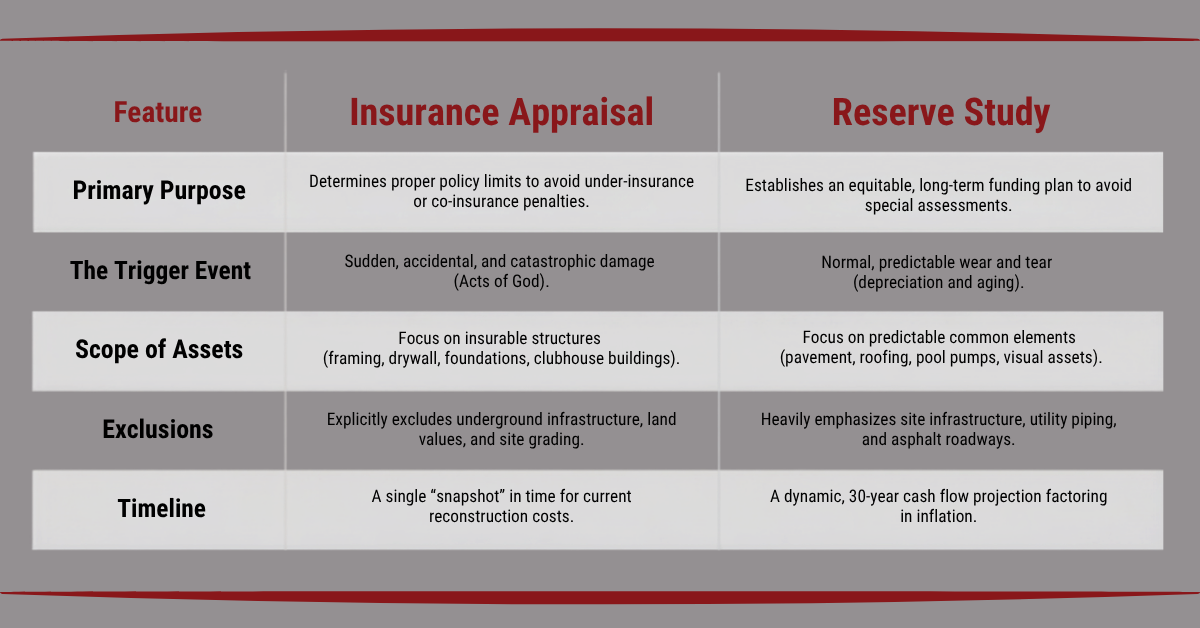
- An Insurance Appraisal asks: “What would it cost to rebuild this entire community from scratch tomorrow if a catastrophic event, like a fire, tornado, or major natural disaster, wiped it out completely?”
- A Reserve Study asks: “How much money do we need to save incrementally over the next 30 years to replace individual common elements as they predictably wear out over time?”
Comparing the Two Financial Tools
To understand how these reports function side by side, look at how their scope, data, and outcomes diverge:
Why One Cannot Replace the Other
Consider a community’s neighborhood asphalt roads. In an insurance appraisal, pavement is largely ignored because a fire or windstorm cannot destroy a road. If a board relies solely on its insurance valuation to plan its financial future, the massive cost of repaving neighborhood streets will be entirely missing from the equation. When the roads inevitably deteriorate, the community will face an emergency special assessment.
Conversely, a reserve study tracks the natural, slow degradation of your roofs over a 20-year lifecycle. But if an unprecedented hailstorm destroys those roofs in year three, your reserve fund isn’t built to handle that immediate, total replacement; that is a claim for your property insurance policy, which relies on an accurate insurance appraisal to pay out fully.
Grounded in Fiduciary Best Practices
State regulatory bodies emphasize how these distinct studies ensure a community’s survival. For example, look at the Virginia Department of Professional and Occupational Regulation (DPOR). Their guidelines and statutory framework outline a strict mandate. A reserve study’s sole purpose is to serve as a capital budget planning tool.
Under the Code of Virginia, boards are required to use these studies systematically. They must determine the physical status of shared components. They must also assess their remaining useful life and exact replacement costs. This process ensures the association adjusts its annual budget correctly. It allows them to maintain sufficient cash reserves. Consequently, they avoid relying on erratic operating cash flow or emergency capital levies.
At the same time, agencies like the Federal Housing Finance Agency (FHFA) track structural and property insurance metrics separately. They note that maintaining accurate, up-to-date insurance valuations is a prerequisite to keeping a community qualified for stable lending and protection against broader financial risk. Failing to update either report independently leaves the board exposed to severe fiduciary liability.
The Takeaway for Your Board
An insurance appraisal protects your community from unexpected disasters. A reserve study protects your community from predictable aging.
Skipping either report leaves your association completely exposed, either to a massive funding gap when common elements fail or to a devastating out-of-pocket shortfall if a disaster hits an under-insured property. Utilizing both ensures your community is fully capitalized for the future and fully protected today.
Is your association’s long-term financial plan accurate, up-to-date, and fully funded? Don’t leave your community’s physical assets to guesswork. Click below to collaborate with our certified specialists and establish a bulletproof funding roadmap for your property.