
Roadways, parking lots, sidewalks, asphalt paths, and parking garage decking all represent major pavement assets that community associations must maintain. Successfully maintaining these surfaces requires a proactive approach.
Pavement takes a relentless pounding. Weather, heavy traffic, chemical deicers, oil slicks, and gasoline spills all contribute to the rapid deterioration of both concrete and asphalt surfaces.
Unfortunately, many communities neglect pavement defects until they become critical. By then, the damage has often progressed to the point where total replacement is the only option. Pavement that should have lasted fifteen years or more frequently ends up failing in as little as five.
What is a Pavement Management Program?
A Pavement Management Program helps communities get the absolute most out of their paved surfaces. By working to identify and correct defects early, boards keep repair costs to a minimum and greatly enhance the community’s overall safety and appearance.
A comprehensive Pavement Management Program consists of three major parts:
-
Education
To many homeowners and board members, it feels counterintuitive to spend money today rather than deferring maintenance costs until a future date, when the pavement can no longer be repaired. However, independent studies have shown that it is six to ten times more cost-effective to repair pavement early than it is to do nothing. To implement a successful program, the board must provide sufficient information to the community regarding these long-term financial benefits.
-
Visual Inspection
To truly understand the condition of a community’s infrastructure, it is essential to conduct a thorough inspection of all pavement once a year, typically in the spring. This timing allows the community an ample window to schedule and make necessary repairs before freezing winter weather sets in. Those responsible for the inspection must be properly trained and possess the skills necessary to accurately evaluate material conditions.
-
Scheduled Repairs
Identifying defects is only the starting point; those defects must be repaired promptly. Communities may not be able to execute all necessary repairs at the same time, particularly during the first year of the program, meaning the board must establish a clear priority list.
Managing Asphalt Pavement
Expected Lifespan: Roadways & Parking Lots (15–25 years) | Asphalt Paths (10–15 years)
Community asphalt includes critical high-traffic areas like community roadways, parking areas, and walking paths. Asphalt is a flexible wearing surface prone to specific defects that require routine maintenance attention.
To maximize its service life, boards should implement the following recommended maintenance practices:
- Clean surfaces regularly: Remove accumulated debris, de-icing salts, and oil to prevent chemical degradation of the top layer.
- Inspect and clear drains: Prevent water from backing up, pooling, and saturating the edges of the pavement.
- Sealcoat every 3 to 5 years: Seal hairline cracks and replenish the vital asphalt binders lost due to weathering and UV rays.
- Seal cracks immediately: Prevent water from gaining access to the base layers where freeze-thaw cycles quickly turn small cracks into deep potholes.
- Patch potholes promptly: Eliminate immediate trip hazards for pedestrians and prevent structural damage to resident vehicles.
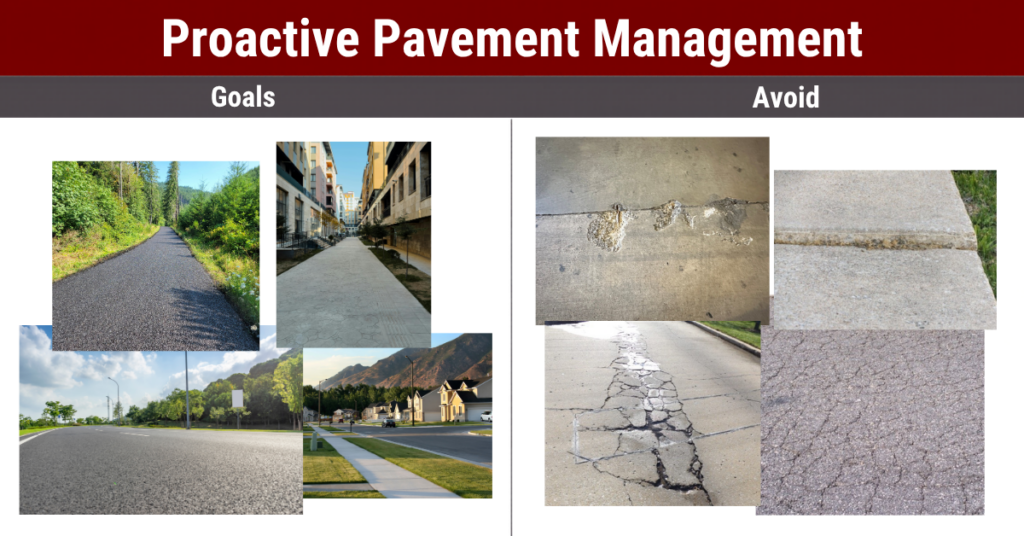
- Remove and replace severe alligatoring: Interlocking cracks that look like alligator skin indicate deep base failure; these sections must be cut out and completely replaced.
- Stripe and repaint: Refresh lines every 1 to 2 years, depending on traffic wear and tears, to maintain safety and curb appeal.
Managing Concrete Pavement
Expected Lifespan: Long-life assets are heavily dependent on construction quality, materials, axle loads, and climate exposure.
The most common concrete structures in a community include common drive aprons, individual driveways, sidewalks, and shared patios. While concrete is exceptionally durable, its rate of deterioration depends on the quality of the initial mix, reinforcement, and local freeze-thaw cycles.
Recommended maintenance practices include:
- Clean sidewalks and patios monthly: Prevent organic debris and mud from staining or becoming permanently ground into the surface texture.
- Seal cracks and open joints: Keep water from seeping beneath the concrete slabs and undermining or washing away the supporting soil base.
- Mitigate trip hazards: Heaved or settled sections of concrete that result in a height difference greater than one inch create severe trip hazards. These must be ground down mechanically or cut out and replaced.
- Address delamination: Improperly mixed or finished concrete can scale and delaminate over time. While temporary repairs can be made using a thin bond coat, permanent remediation usually requires full slab replacement.
Managing Parking Garage Decking
Expected Lifespan: High-risk structures requiring rigorous preventative maintenance to avoid catastrophic structural costs.
The concrete decks inside enclosed or multi-level parking garages require specialized, heightened maintenance to prevent serious structural damage to embedded reinforcing steel.
Recommended maintenance practices include:
- Routine deck sweeping and washing: Wash down decks regularly to flush out accumulated road salt, winter deicers, grime, and automotive fluid spills.
- Verify drainage flow: Keep all floor drains clear of debris to prevent water ponding on the flat concrete surface.
- Refresh traffic markings: Repaint line striping, direction markers, and pedestrian crosswalks on a 1-to-2-year cycle to maintain traffic safety.
- Apply water-proof coatings: Apply specialized, elastomeric traffic coatings to block water and road salts from soaking into the concrete and rusting the internal rebar. Most coatings last roughly 10 years, but you should visually inspect the surface every 6 months for signs of breach or wear.
- Patch spalled concrete: Address areas where chunks of concrete have broken away (spalling) by patching them with specialized repair mortars before reinforcement steel erodes further.
- Inspect and replace expansion joints: Maintain the watertight integrity of expansion joints to stop aggressive leaks onto the levels below.
The Ultimate Pavement Safeguard: Your Reserve Study
At the end of the day, you can have the best intentions and the most diligent maintenance checklists. But, without proper financial backing, your pavement management program will stall.
Because asphalt and concrete are among the most expensive assets your community owns, guessing at their remaining lifespans or underfunding their replacement can lead to catastrophic special assessments or sudden, unmanageable bank loans.
That is where a professional Reserve Study becomes your board’s greatest asset.
A comprehensive Reserve Study doesn’t just look at your current financial accounts. It includes a professional physical analysis of your community’s roadways, sidewalks, and parking decks. It precisely maps out exactly when these surfaces will fail. And exactly how much money you need to have in reserve to fix them when that day comes.
Take the Guesswork Out of Your Budget
Fulfilling your fiduciary duty means protecting your community’s infrastructure using real data, not guesswork. Don’t wait for alligator cracks to turn into potholes or for a sidewalk liability lawsuit to cross your desk.
Ready to protect your community’s pavement and secure your financial future? Click here to request a comprehensive Reserve Study proposal today.