
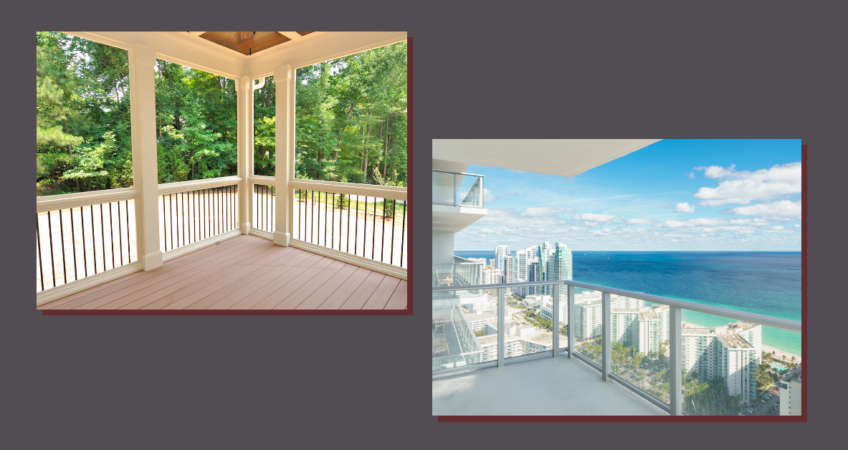
When completing work on community decks and balconies, it can be incredibly difficult to determine if the work falls under maintenance or reconstruction.
Understanding this difference is critical, as it often determines who is responsible for paying for the work. A community’s governing documents (such as the CC&Rs) will explicitly identify whether a balcony or deck is a unit owner’s responsibility, a common element, or a limited common element.
- Unit Owner Responsibility: If it belongs entirely to the homeowner, there is no question as to who pays.
- Common or Limited Common Elements: When the structure is shared or maintained by the community, the line between routine maintenance and full-scale construction becomes vital, yet it is often blurry.
According to the Community Associations Institute (CAI), regular preventative maintenance and structural safety inspections are paramount to preventing catastrophic structural failures and ensuring community safety. Let’s break down where these lines are drawn for both wood decks and concrete balconies.
Wood Decks: Maintenance vs. Renovation
Deck Maintenance Activities
Most governing documents state that general maintenance of a deck or balcony is the responsibility of the homeowner. In general, maintenance means general upkeep and minor, localized repairs. These activities are relatively inexpensive and can be reactive (fixing a minor issue) or proactive (extending the service life of the components).
Unless your governing documents state otherwise, typical owner-led maintenance includes:
- Periodic cleaning of deck surfaces and railings.
- Annual or semi-annual staining and waterproofing of deck boards and railings.
- Cosmetic upkeep to maintain the overall appearance of the deck.
- Repair of the flashing that seals the deck to the building.
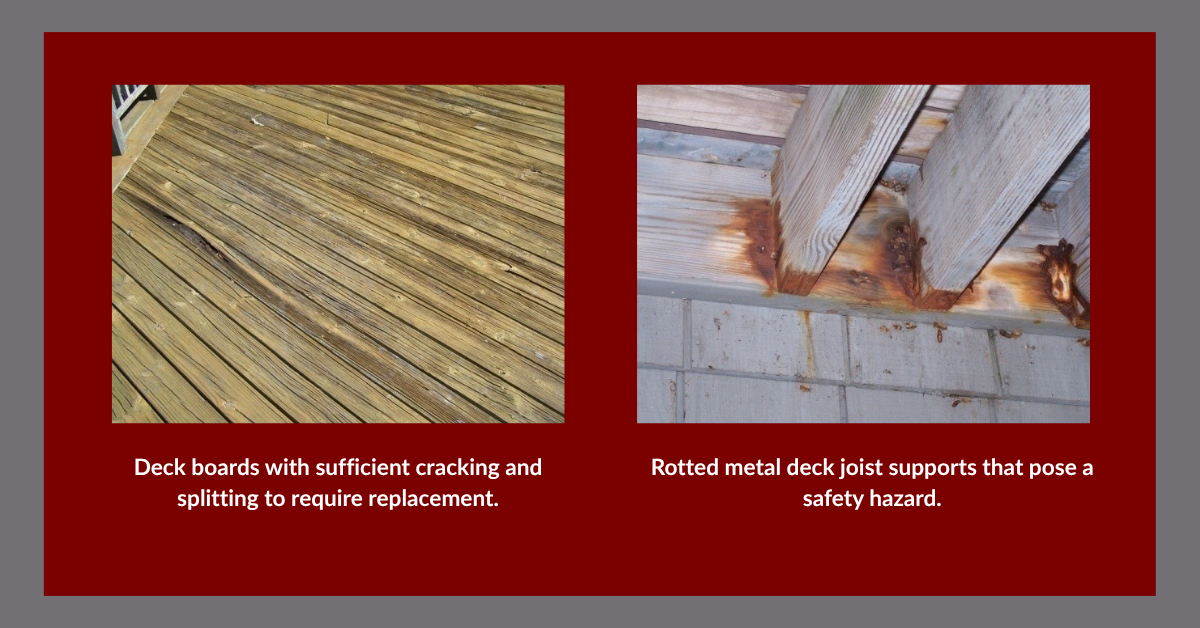
- Minor board replacement (including individual boards with rot, weak areas, or structural cracks).
Note for Boards: If an association board decides that an activity like power washing or staining needs to be executed across all decks simultaneously to preserve the community’s assets, the cost may be covered by the association’s general maintenance budget rather than individual owners.
Deck Renovation & Reconstruction Activities
In contrast, reconstruction projects are much more involved. They typically fall entirely to the Association and are funded through the community’s Reserve Funds.
Reconstruction is required when components reach the end of their useful service lives, sustain significant structural damage, or need upgrades to stay compliant with updated local building codes. These projects extend well beyond a single unit and often impact the entire community.
Typical association-funded reconstruction tasks include:
- Comprehensive professional inspections to identify deep structural deficiencies or hazards.
- Complete replacement of the entire decking surface, railing systems, and underlying structural support components (such as rotted metal deck joist supports or failing beams).
- Total structural upgrades to satisfy modern safety codes.
Concrete Balconies: Upkeep vs. Structural Overhauls
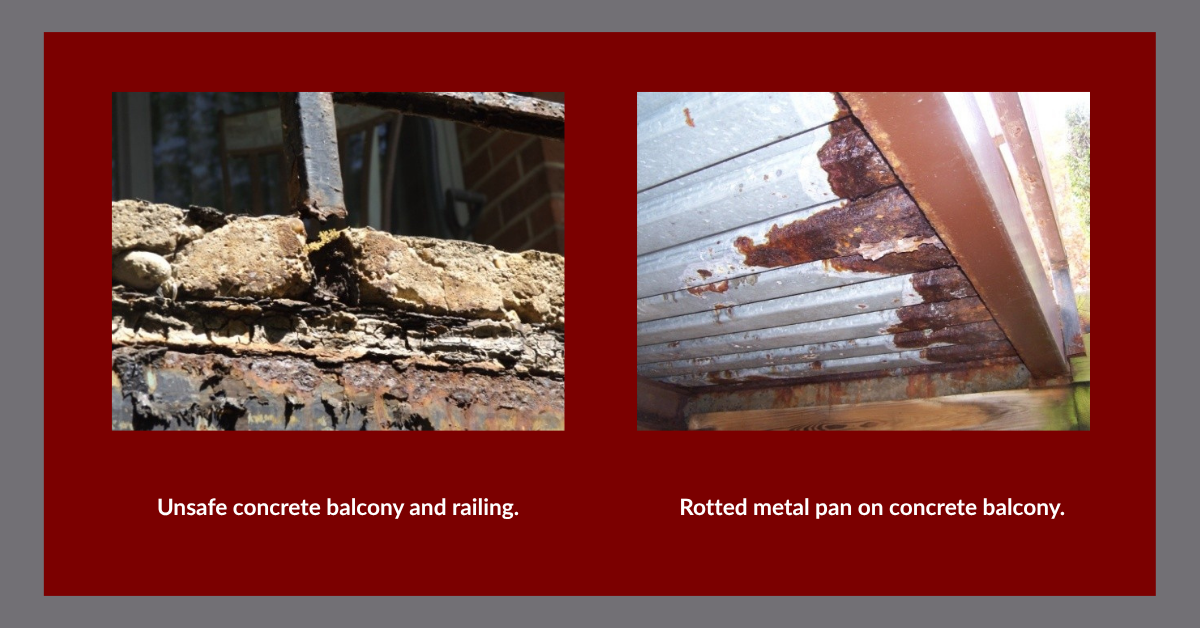
Concrete balconies require a completely different approach to prevent accelerated deterioration, such as concrete spalling (flaking or breaking chunked concrete) caused by rusted internal steel reinforcements.
Balcony Maintenance Activities
Just like wood decks, concrete balconies require regular homeowner upkeep to protect the slab from water intrusion. Routine owner maintenance includes:
- Periodic cleaning of concrete surfaces and railings.
- Clearing leaves and debris from built-in drains.
- Regular removal of snow, ice, and ponded water.
- Avoiding the installation of outdoor carpet. Carpet acts like a sponge, trapping moisture directly against the concrete and severely accelerating the corrosion of the internal reinforcing steel rebar.
Balcony Reconstruction Activities
While regular maintenance extends the balcony’s lifespan, system-wide failures or severe material degradation will eventually necessitate partial or complete reconstruction. Unless governing documents state otherwise, these high-cost projects are covered by the community’s Reserve Funds and include:
- Annual structural and safety inspections of the slabs and railing connections.
- Patching or full replacement of specialized waterproofing membranes.
- Repair or replacement of balcony flashings to stop water from penetrating the building’s exterior envelope.
- Sealing railing pitch pockets to prevent water from leaking into the concrete foundation.
- Filling and sealing structural concrete cracks.
- Major structural repair of failing concrete sections or a rotted metal pan support.
- In severe cases, total demolition and replacement of the entire balcony structure.
The Golden Rule: Inspect, Inspect, Inspect
The single most critical step owners and Associations can take to ensure long-term structural health is establishing a schedule of thorough, frequent inspections. Early identification allows you to catch minor visual defects before they balloon into expensive, catastrophic structural failures.
While owners can easily spot surface issues like ponding water, failed deck boards, or peeling waterproofing coatings, professional annual inspections must delve deeper. They must analyze code compliance, structural integrity, flashing health, and deep hidden decay. Furthermore, an increasing number of states now legally mandate that balconies and multi-family decks be inspected on a strict schedule by a properly licensed structural engineer or specialist.
Is Your Reserve Study Up to Date?
Accurately tracking the lifespans of your community’s decks and balconies is vital to ensure your association has the funds ready when it’s time for major reconstruction. Don’t let unexpected structural failures drain your operating budget.