

For most Community Associations, a pond is a scenic asset—a peaceful water feature that adds curb appeal and value to homes. However, for a Reserve Study specialist, a pond is something else entirely: a stormwater management system with a hidden, and potentially massive, future expense.
While your landscaping crew mows the banks and treats the algae, a silent process is happening underwater that—if ignored—can devastate your community’s budget.
This is why Bathymetric Studies are a critical component of a comprehensive Reserve Study.
What is a Bathymetric Study?
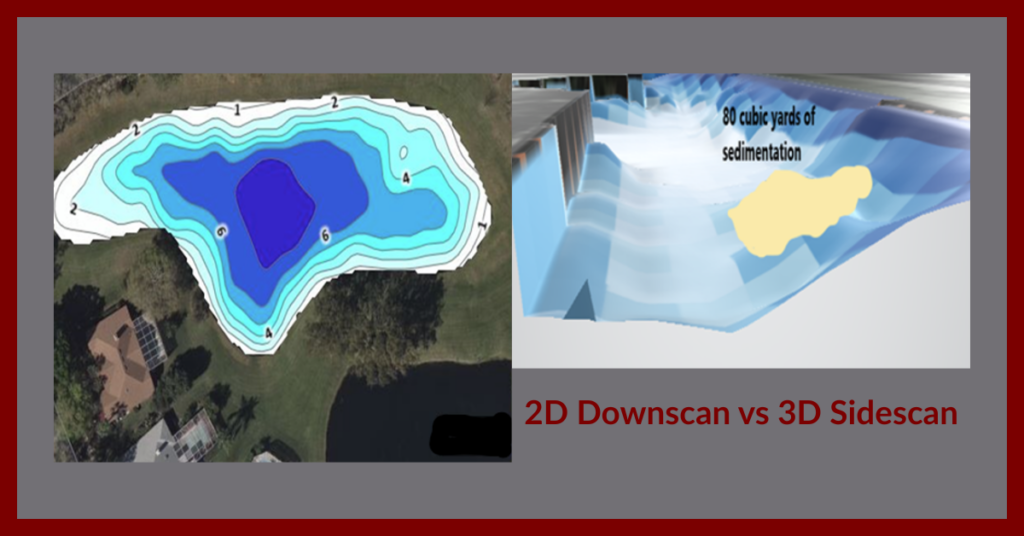
Simply put, bathymetry is the underwater equivalent of a topographic map. Using specialized sonar and GPS technology, professionals map the “floor” of your pond.
Unlike a visual inspection, which only assesses the water’s surface and the shoreline, a bathymetric study reveals:
- The current water depth.
- The contours of the pond bottom.
- Most importantly: The volume of sediment that has accumulated over time.
The Hidden Financial Threat: Sedimentation
Every retention pond has a finite lifespan. From the moment a pond is dug, it begins to fill up. Runoff from rain carries sand, dirt, leaves, and organic debris into the basin. Over time, this sediment builds up on the bottom, drastically reducing the amount of water the pond can hold.
As noted by the Penn State Extension in their article on Pond Ecology, ponds undergo a natural aging process, where they fill with sediment and organic matter. Without intervention, a pond will eventually turn into a wetland and then dry land.
To prevent this, the pond must eventually be dredged, a mechanical process to scoop out the sludge and restore the pond’s depth. This is often one of the most expensive capital projects an HOA will ever face.
Identifying Repairs
A bathymetric Study will also identify the sources of the sedimentation so that they can be mitigated or eliminated. Whether it is non-organic sediment such as sand and dirt coming through storm drainage pipes, or areas of eroding and collapsing shoreline, steps can be taken to repair and control these sediment sources based upon the information gathered in the bathymetric study. Addressing these sources will reduce the need for future sediment removal.
Why This Matters for Your Reserve Study
A Reserve Study is all about accurate forecasting. If your reserve analyst is forced to estimate dredging costs based on visual guesses, your community is at risk. Here is how hard data protects you:
- Accurate Cost Projection
Dredging contractors typically charge by the cubic yard of material removed.
- Without Bathymetry: We are estimating the volume.
- With Bathymetry: We know exactly how many cubic yards of sediment are currently in the pond. This allows for a precise financial calculation in your funding plan, ensuring you aren’t underfunded by $50,000 or more when the bill comes due.
- With Bathymetry: significantly reduce or eliminate the need for expensive dredging in the future.
- Establishing a Timeline (Useful Life)
By comparing the original design depth of the pond against the current depth found in the bathymetric study, we can calculate the rate of sedimentation.
- Example: If the pond has accumulated 2 feet of sediment in 10 years, and it can handle 4 feet before failure, we can scientifically predict that dredging will be required in roughly 10 years. This prevents the dreaded “surprise special assessment.”
- Regulatory Compliance
Retention ponds are legally required functional utilities designed to prevent flooding. If your pond is too full of silt to hold stormwater during a heavy storm, it may overflow, causing property damage. Municipalities can inspect and fine communities for non-compliant stormwater systems. A bathymetric study serves as proof that you are actively monitoring the asset.
The ROI of “Looking Down”
It is tempting for Boards to skip the bathymetric study to save a small amount of money in the short term. However, the cost of the study is a fraction of the cost of an emergency dredge project.
Integrating a bathymetric survey into your Reserve Study cycle ensures that when the day comes to dredge, the money is already in the bank. It changes a potentially catastrophic financial event into a manageable, planned expense.
The Bottom Line
Don’t let your pond become a financial sinkhole. If your community has a retention pond that is over 10 years old and has never been mapped, it is time to look beneath the surface.
Is your community due for an update? Contact us today to discuss how we can incorporate sediment analysis into your next Reserve Study.